Schengen visas, made easy
From expert consultation to fully handling your application, we offer the complete range of Schengen visa services — your trusted, proven partner every step of the way.
What people say about our Schengen visa service
We guide you through every step of your application
Whatever your route, you get the same trusted VisaHQ expertise — whether you just need advice or want us to take the whole process off your plate.
Consultation
Expert guidance — you submit the application yourself.
- Answer all your questions
- Explain your destination’s specific requirements
- Pre-check your documents before the embassy visit
- Prepare you for the interview
- Help you complete the application form
Full service
We manage your application end-to-end — where available for your country.
- Everything in Consultation, plus:
- Gather and prepare the correct documents
- Complete and manage your application forms
- Appointment scheduling where required — subject to availability and the visa centre’s, consulate’s or authority’s procedures
- Meet & Greet support in selected locations — subject to local availability during submission
- Keep your case on track end-to-end
Which option is available depends on your citizenship and destination — start above and we’ll show you the exact path for your trip.
See My OptionsVisaHQ does not handle the physical submission in every country; submission support, Meet & Greet and appointment scheduling depend on your destination and local availability.
Schengen visa information
A Schengen visa is a travel document that allows a person to enter the Schengen Area for a designated period of time. The Schengen Area is made up of European states that have abolished internal border checks and apply a common visa policy.
As of 2026 the Schengen Area includes 29 member countries — 25 European Union states plus Iceland, Liechtenstein, Norway and Switzerland. A valid Schengen visa issued by any member state lets you travel freely to the other Schengen states for the duration of your stay, as long as you have proof of your travel arrangements. You normally enter the area through the country of the issuing authority or your main destination.
A Schengen visa is the perfect way to discover Europe — one document opens the door to dozens of countries, letting you experience the continent’s remarkable diversity and immerse yourself in its many cultures and local traditions.
Everything about Schengen visas
Schengen visa countries
Select a country below for visa requirements. The newest members — Croatia (2023) and Bulgaria & Romania (full members since January 2025) — are now part of the Schengen Area.
Schengen visa requirements
Travelers must fulfil the following requirements in order to apply for a Schengen visa.
Schengen visa application process
Check if you need a Schengen visa and select which country’s visa you will be applying for.
Download and complete the application form entirely, then sign it.
Obtain proof of insurance from your insurance company.
Prepare a bank statement and other financial documents that prove you have sufficient funds for your travel.
Make an appointment at the embassy or consulate of your main (longest stay) destination — ideally 2–3 weeks before travel.
Submit all the documents.
The consulate usually takes 3–4 business days to process, but confirm your pickup date in case of delays during high season.
Schengen visa fees
A nominal, non-refundable fee is payable when applying. Approval is at the discretion of the consulate.
| Visa type | Visa fee |
|---|---|
| Short stay (up to 90 days) | 90.00 EUR |
| Long-term stay (over 90 days) | 99.00 EUR |
| Children visa (6–11 years old) | 45 EUR |
| Children visa (under 6 years old) | Free / Gratis |
| Citizens of countries with an EU visa-facilitation agreement (Armenia, Azerbaijan, Belarus, Cape Verde) | 35 EUR |
| Students and accompanying teachers travelling for educational purposes (proof needed) | Free |
| Researchers travelling for scientific research purposes (proof needed) | Free |
| Non-profit representatives aged 25 or below travelling for educational events | Free |
* Different rates may apply for different Schengen countries.
How to apply for a Schengen visa
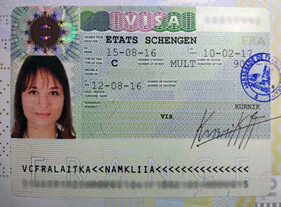
At this time there is no possibility to apply for a Schengen visa online instead of going to the consulate in person. You need to complete the forms, collect all the documents (see the checklist below) and apply directly at the consulate.
First, book your appointment in advance. Plan it at least 15 days before your intended departure, but not earlier than 6 months before you travel.
Fill in the application form and make sure you do not leave blank fields. If some answers cannot be given, write “N/A” in the appropriate field.
After your appointment is scheduled and the form is filled, double-check the required documents and take a passport-type photo that meets the background and size requirements.
Attend your appointment on time and be ready to answer questions about your travel plans and personal details (education, job position, company background).
Some countries (e.g. Italy, France) require biometric identifiers (fingerprints and a digital photograph). This information is stored on the Visa Information System (VIS) and can be reused for your next Schengen applications.
Do I need a Schengen visa?
Type your country of citizenship to check instantly. You may also apply from your country of permanent residence, not only your country of citizenship.
The countries below require a Schengen visa before travelling (Annex I of EU Regulation 2018/1806). Nationals of all other countries are either visa-exempt for short stays (Annex II) or have EU/EEA free movement; holders of a valid Schengen residence permit are also exempt.
- Afghanistan
- Algeria
- Angola
- Armenia
- Azerbaijan
- Bahrain
- Bangladesh
- Belarus
- Belize
- Benin
- Bhutan
- Bolivia
- Botswana
- Burkina Faso
- Burundi
- Cambodia
- Cameroon
- Cape Verde
- Central African Republic
- Chad
- China
- Comoros
- Congo Republic
- Ivory Coast
- Cuba
- Congo Democratic Republic
- Djibouti
- Dominican Republic
- Ecuador
- Egypt
- Equatorial Guinea
- Eritrea
- Swaziland
- Ethiopia
- Fiji
- Gabon
- Gambia
- Ghana
- Guinea
- Guinea Bissau
- Guyana
- Haiti
- India
- Indonesia
- Iran
- Iraq
- Jamaica
- Jordan
- Kazakhstan
- Kenya
- Kuwait
- Kyrgyzstan
- Laos
- Lebanon
- Lesotho
- Liberia
- Libya
- Madagascar
- Malawi
- Maldives
- Mali
- Mauritania
- Mongolia
- Morocco
- Mozambique
- Myanmar
- Namibia
- Nauru
- Nepal
- Niger
- Nigeria
- North Korea
- Oman
- Pakistan
- Papua New Guinea
- Philippines
- Qatar
- Russia
- Rwanda
- Sao Tome Principe
- Saudi Arabia
- Senegal
- Sierra Leone
- Somalia
- South Africa
- South Sudan
- Sri Lanka
- Sudan
- Suriname
- Syria
- Tajikistan
- Tanzania
- Thailand
- Togo
- Tunisia
- Turkey
- Turkmenistan
- Uganda
- Uzbekistan
- Vanuatu
- Vietnam
- Yemen
- Zambia
- Zimbabwe
Insurance for a Schengen visa
Travel insurance is required for a successful Schengen visa application. Your insurance should cover €30,000 and be valid in all Schengen member states, not only in your country of destination.
Travel insurance usually also includes cancellation cover for losses from lost luggage, cancelled flights and other force-majeure events.
When choosing insurance for a Schengen visa application, make sure the document is valid for all member countries, not only your destination country.
Documents required — checklist
A general list for all countries — always also check the specific requirements of the country you are visiting.
Passport — valid at least 3 months after your return, with at least 2 blank pages.
Photo — passport type.
Visa application form — filled in and signed.
Proof of travel medical insurance.
Proof of accommodation — booking, etc.
Proof of sufficient means of subsistence — bank statement, etc.
Contact information for a reference in the visiting country.
Proof of stable income — tax information, etc.
Proof of employment or enrolment in your country of residence.
Copies of all the documents.
Copies of all Schengen visas issued to you in the past.
Letter of invitation — if attending an event, meeting or conference.
* All documents are to be A4 format. You may also be required to provide proof of entrepreneur status, family status (e.g. marriage certificate) or a national passport in some countries.
Schengen visa map
Schengen visa: frequently asked questions
Clear answers on getting a Schengen visa, using it across Europe, and the perks it unlocks for travelers.